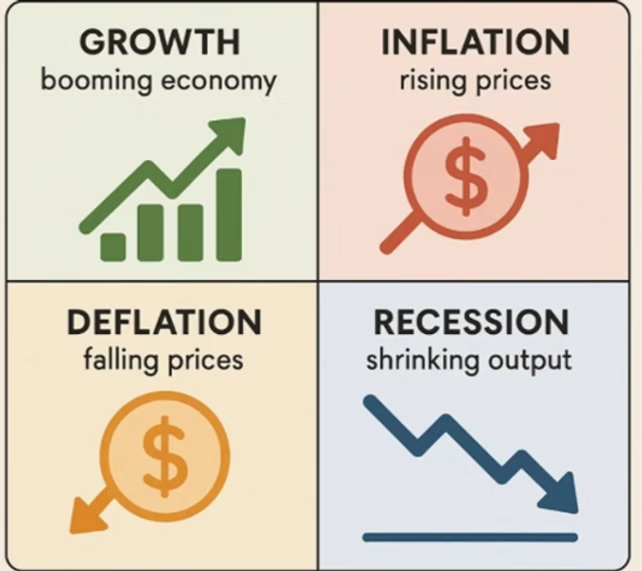
The second quarter continued with increases in interest rates by ECB, FED, and Bank of England. The Bank of England was quite aggressive and put the rates up by 0.75% per annum. Apart from UK, these increases were expected and did not affect the markets much.
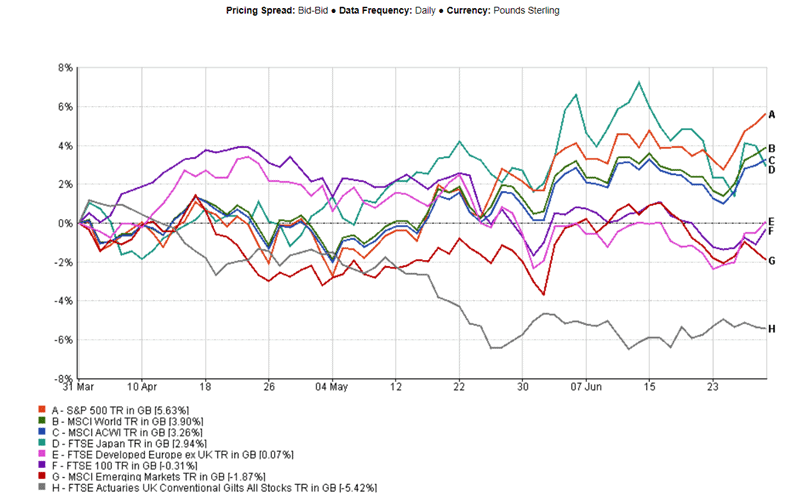
Equities (as per MSCI World index) were up by 3.90% and Sterling Bonds (as per Bloomberg Sterling Aggregate Index) were down by 5.6%, mainly due to the aggressive raise in interest rates in the UK.
There was a continuation of the recovery in the technology sector, mostly led by stocks related to Artificial Intelligence (AI) like Microsoft, Alphabet, nVidia, Palantir Technologies, Meta Platforms, Snowflake, and a few other semiconductor companies. Some healthcare companies like Eli Lilly, Novo Nordisk, continued to do well, suggesting that demand for molecules which help with losing weight would be very high, especially following the study this will also reduce heart attack and other illnesses.
It has become clearer that we will avoid a recession (at least in the U.S.), so as a result Consumer discretionary have outperformed the MSCI Word Index (7.54%), but also industrials and financials performed better. Laggards were Consumer staples, healthcare, energy, and utilities.
Geographically, UK, Europe and Emerging markets underperformed, and Japan did relatively well, due to its cheap valuations.
We have not made changes throughout the quarter to asset allocation or fund selection.
Inflation seems to remain stubbornly high, and this would lead to further interest rates increases later in the year. This seems to be due to low unemployment, and the price increases are mostly in the services sector, which are around 65% for the developed economies.
Historically, U.S. stock prices have remained at a relatively high valuation, however, this is somehow explained by forecasted free cashflows and their expected increases, like in the U.S. where earnings increases are flat like in Japan, Europe and UK, stocks are trading at lower valuations. Professor Damodaran explained in one of his latest posts, that the U.S. implied risk premium is around 4.4% per annum, so the expected equity return, once adding the risk free rate, is 8.4% per annum.
(27) The Price of Risk: With Equity Risk Premiums, Caveat Emptor! – YouTube
In the previous letter, we were looking at revenue and Earnings per share (EPS) for the first five big companies and explained that some of them may not be able to increase their revenue and EPS. We have just had Apple’s results for the second quarter, and revenue was down $1.2 billion, however the EPS increased by 5% to $1.26 from $1.20, helped a bit by the reduction in the number of shares (due to buybacks) by 3% and by the increase in the revenue from services which is more profitable. Some of the buybacks were done by taking more debt on the balance sheet (another $3.3 billion) with long term debt now at $98 billion.
We will continue to remain underweight to Apple, Amazon, Alphabet, and nVidia, where we decided to take some profits to take advantage of the high stock price.
****
In terms of what worked well for N2 Asset Management, I would mention Eli Lilly and Co, up 49%, Palantir Technologies, up 101%, nVidia, up 51%, Lam Research, up 23%, Uber, up 39%, and Meta Platforms, up 36%. Most of our holdings in the Energy, consumer staples, discretionary (Diageo, LVMH), industrials (Caterpillar, and defence companies), healthcare were flat for the second quarter, although we witnessed some good performance in July when earnings were published for the second quarter.
A special mention to a new addition to our portfolios, a financial named Fiserv Inc (up 11.5% for the second quarter). It helps merchants take payments when ordering online, for example now, when going to McDonald’s (a client of Fiserv), you can order through the app, and when arriving, you just collect the food and the coffee. We also have another payment company in our portfolios – Adyen NV.
****
We will close by reminding you that most likely you are in what we name the “fragile” period (age 55 to 70) where real investment performance is very important. Your financial plan has clear growth assumptions and not meeting those, would mean that financial objectives around retirement will have to change. We are working hard for you to avoid this happening.
Past performance is not a guide for future investment return.